Earthandotherunlikely

  • Subscribe to our RSS feed.
  • Twitter
  • StumbleUpon
  • Reddit
  • Facebook
  • Digg

Thursday, 11 August 2011

Red Remembered Hills

Posted on 12:15 by Unknown
 
Credit: NASA / JPL / Cornell / Damien Bouic

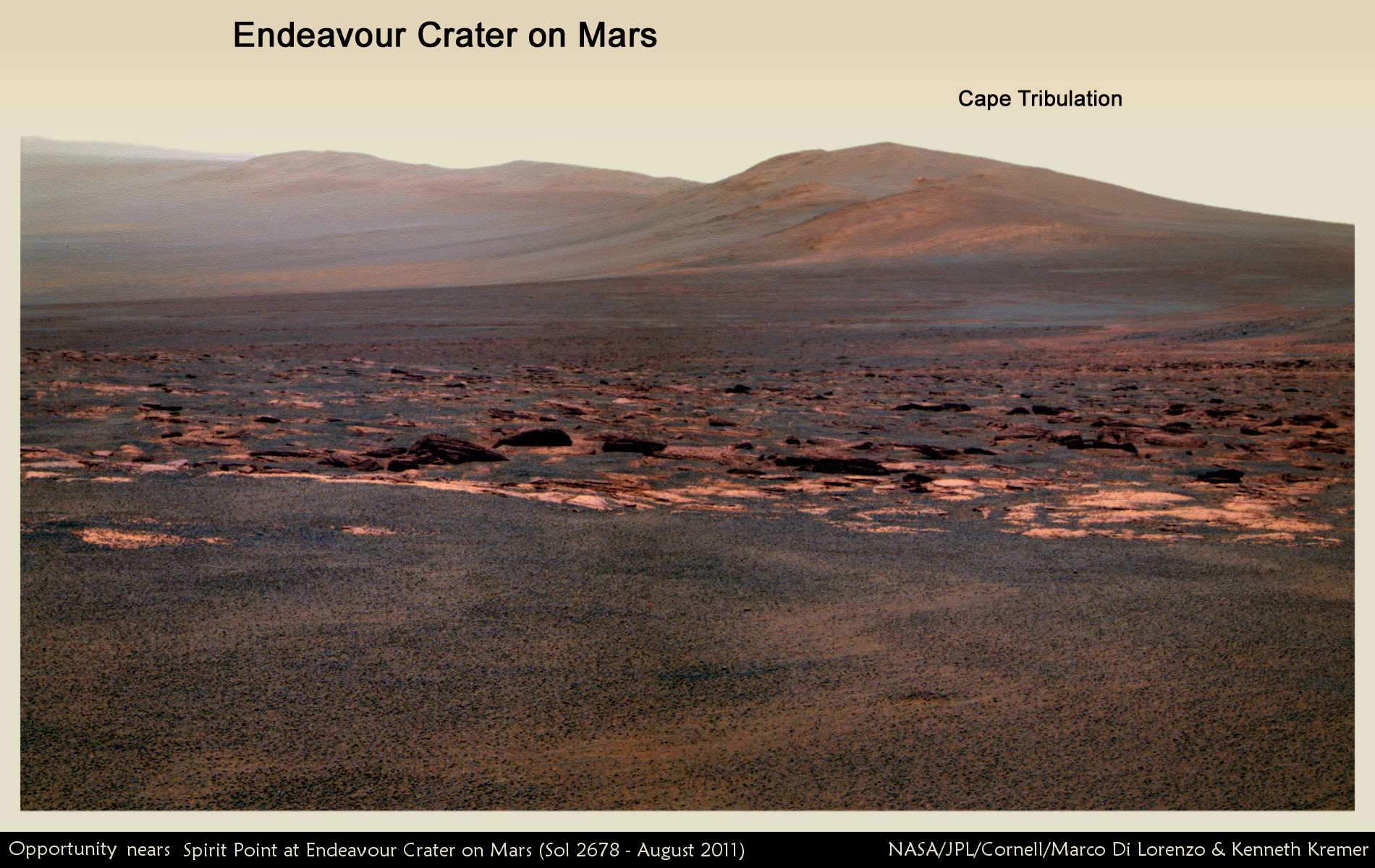
The two rovers, Spirit and Opportunity, have taken many panoramic pictures of the Martian landscapes they've traversed, but I think that this is one of the loveliest.  (To see it full-size, check out the entry in the Planetary Society's blog, where I found it; a variation on the same scene can be found here.)  It's a view taken by Opportunity two days ago, looking across the western foothills of the rim of Endeavour Crater, and it's lovely for two reasons.

The first, for those who have been following the progress of the rovers since they landed on Mars more than seven years ago, is that this is the end of a small but epic journey of some 21 kilometres that began in 2008, after Opportunity left Victoria Crater.  All that time, driving backwards because one of her front wheels is jammed, the rover has traversed a landscape of rippled sand and exposed plates of rock, interrupted by the occasional smashed dish of a small crater.  Twenty-one kilometres - 13 miles - doesn't sound much.  A good afternoon's ramble.  But Opportunity is no bigger than a golf cart, is long past her warranty date (she was supposed to operate for only 90 Martian days, or sols), is being steered by remote control by operators on Earth, and the terrain, while it has been mapped and photographed by orbiting spacecraft, contains unknown perils and traps. While Opportunity was travelling, her sister rover, Spirit, became inextricably stuck in a patch of loose sand, and succumbed to the Martian winter after operating as a stationary science platform for more than a year.  Opportunity ploughed on, backwards.  At sol 2681 she finally reached Spirit Point, named after her sister rover and at the edge of a ridge known as Cape York.  Now she's ready to begin the science part of her fifth mission extension.  Endeavour Crater is some 22 kilometres across, much bigger than Victoria Crater.  The rock layers exposed by the impact that created it are deeper and older, and there are signs that some of the layers are clay-bearing phyllosilicates formed in the presence of water.

But the other reason it's an especially lovely view is that it is in many ways quite Earth-like.  The ridges may mark the edge of an impact crater (and the rocks in the foreground were thrown from another much small impact crater beyond the right-hand side of the photomosaic), but they have been eroded into soft shapes by millions of years of wind-blown sand, and they are also softened by the hazy atmosphere, giving a very familiar effect of a landscape fading into the distance.  Alien and familiar, they wouldn't look out of place in an Earthly desert. It's very easy to imagine standing there, and walking forward into the unknown.
Email ThisBlogThis!Share to XShare to FacebookShare to Pinterest
Posted in | No comments
Newer Post Older Post Home

0 comments:

Post a Comment

Subscribe to: Post Comments (Atom)

Popular Posts

  • Links 26/07/13
    The glowing blue wave of death : '...an international team of researchers has found evidence of a “cascade” of death that spreads throu...
  • Science Fiction That Isn't Science Fiction (8)
    A short non-canonical list: The Alteration - Kingsley Amis Queen Victoria's Bomb - Ronald W. Clarke SS GB - Len Deighton Revelation Da...
  • Out There
    Last week my British publisher, Gollancz, dropped the price of the ebook version of The Quiet War to £1.99 , to help promote the publicatio...
  • Science Fiction That Isn't Science Fiction (7)
    Writers who locate themselves outside the science-fiction genre tend to employ the dystopian mode when they write about the future. They d...
  • ReBooting Britain
    My short article on first, simple steps to make cities greener, and many others on ReBooting Britain , in Wired UK.
  • Meteorphagy
    So apparently the Mars rover Curiosity has found something very interesting in the soil it scooped up in Gale crater , but we won't know...
  • The Only Thing That Went Through The Mind Of The Bowl Of Petunias As It Fell Was Oh No, Not Again.
    Just when you think you’re out, they drag you back in. I really didn’t want to write anything else about literary and genre fiction for a ...
  • Life As We Know It
    It was a slow night at the Still Point. A little after midnight, Aeshma was thinking of closing up when an old man ankled up and slid onto o...
  • Coming Soon
    (Illustration by Dave Elsey)
  • Links 17/05/13
    While Apollo 17 astronauts Eugene Cernan and Harrison Schmitt visited Earth's moon for three days in December 1972, they drove their mis...

Blog Archive

  • ►  2013 (94)
    • ►  August (3)
    • ►  July (18)
    • ►  June (16)
    • ►  May (13)
    • ►  April (9)
    • ►  March (12)
    • ►  February (11)
    • ►  January (12)
  • ►  2012 (108)
    • ►  December (17)
    • ►  November (16)
    • ►  October (11)
    • ►  September (3)
    • ►  August (5)
    • ►  July (10)
    • ►  June (10)
    • ►  May (4)
    • ►  April (8)
    • ►  March (6)
    • ►  February (5)
    • ►  January (13)
  • ▼  2011 (107)
    • ►  December (19)
    • ►  November (14)
    • ►  October (8)
    • ►  September (7)
    • ▼  August (5)
      • Some Remarks on In The Mouth of the Whale
      • Sense/Memory
      • Spaceships That Aren't Really Spaceships (1)
      • Retromania
      • Red Remembered Hills
    • ►  July (9)
    • ►  June (1)
    • ►  May (6)
    • ►  April (6)
    • ►  March (8)
    • ►  February (11)
    • ►  January (13)
  • ►  2010 (84)
    • ►  December (14)
    • ►  November (2)
    • ►  October (4)
    • ►  September (9)
    • ►  August (7)
    • ►  July (9)
    • ►  June (5)
    • ►  May (3)
    • ►  April (4)
    • ►  March (5)
    • ►  February (11)
    • ►  January (11)
  • ►  2009 (107)
    • ►  December (14)
    • ►  November (23)
    • ►  October (26)
    • ►  September (28)
    • ►  August (16)
Powered by Blogger.