


Saturday, 15 January 2011
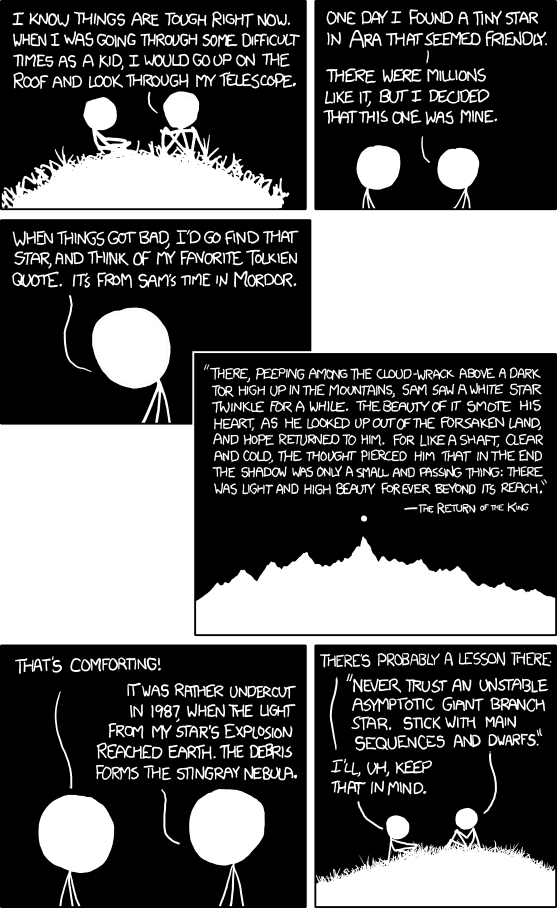
Here were Joshie's beginnings. A dystopian upper-class childhood in several elite American suburbs. Total immersion in Isaac Asimov's Science Fiction Magazine. The twelve-year-old's first cognition of mortality, for the true subject of science fiction is death, not life. It will end. The totality of it. The self-love. Not wanting to die. Wanting to live, but not sure why. Looking up at the nighttime sky, at the black eternity of outer space, amazed.Which set me to thinking about my own long-ago self, when he was at that golden age. Was he really getting into death, back then, when he got hooked into the mainline of SF? I don't think that he thought that he did. He was a bright, disorganised kid living in a small town, and like many such he wanted to get out. SF opened up new worlds to him. America. The future. Easy travel to other planets. And some of his favourite stories - Theodore Sturgeon's 'The Way Home', Tiptree's 'Beam Me Home' - were about about ways of escape. When he looked up at the stars in the summer nights sky, he wasn't thinking about eternity. He was wondering if someone like him was up there on a warm wet blue planet circling a yellow star, looking up at their night sky and thinking what he was thinking. He was projecting. He wanted out bad, and SF was balm to that ache.
Gary Shteyngart, Super Sad True Love Story
Well I got out, and I became a scientist, which is what I wanted to be, and then I became an SF writer, which I also wanted to be, and how cool is that? And now I think, about the SF I read and the SF I write: yeah, in one way or another, it's all about death. I'm just starting in on the editing process of a novel about avoiding the inevitable and the costs this could incur, which is one reason the quote caught my interest. It's something I've been thinking about. Also, when I tweeted part of the quote at the head of this, my friend Andrew McKie tweeted back 'I have long maintained the death thing. There's audio somewhere of me droning on to Kincaid about it at a BSFA thing.' Hard to argue about this with Mr McKie: he once worked for the best bit of the Telegraph - the obits department. To borrow a line from Michael Connelly, death is his beat.
I used to think SF was all about change, but all change means leaving something behind. I left behind my childhood when I quit that little town for university, and never really came all the way back. Death is a more permanent kind of change. And if you avoid it somehow, that will change you too. You won't be some eternal extropian twentysomething, planning to turn a galaxy into beer and pizza. You'll be something so deeply weird the future equivalent of all the world's armies would try to take you down if you ever returned to Earth.
But we're not just talking about childhood's end, or the all-too-brief span of human life, in SF. We're talking about the end of everything. The end of the universe, maybe flattening out forever, maybe crunching back down into the Singularity of a new universe, maybe giving birth to hundreds of new universes. We're talking about the end of reality. We're talking about hard, important questions. If everything is in flux, what is useful and what isn't? What do we do with our knowledge about the immensity of the universe and the seemingly microscopic size of our place within it? How can we make sense of that, and learn to live with it? Is it really possible to develop strategies to avoid the heatdeath of the Universe or surfing the wave of a new Big Bang? And what then? And what then...
Tuesday, 11 January 2011
Thanks to everyone who took the trouble to comment here or on Twitter. All very useful, especially as there was reasonably general agreement about the price range. It seems to me that if I go ahead with this crazy idea I should price the OOP collections at around £4.20 (which includes the VAT eBooks attract), or possibly a little lower. That would come in at a little under $7 at the current exchange rate, which might be a bit high for US readers, but perhaps not too high (Would they have to pay VAT? I realise that I have no idea. If not, the price would be well under $6.) That's somewhat less than the price my UK publishers are charging for a couple of OOP novels that have sneaked out as eBooks. I wouldn't charge much more for the new collection, to be honest. All of three would consist of reprinted stories after all.
A couple of other points, if you can bear it (authors do tend to go on and on about eBooks, so forgive me). The price of printing a book is only a small part of the cover price. Editing, production design, maintaining offices and warehousing and distribution add a bit more. A large chunk goes to the end seller; much smaller chunks go to the publisher and author. So the idea that eBooks are much cheaper to produce because they aren't physical objects isn't exactly right; although they are somewhat cheaper, new books still have to be edited, given cover art and so on. As for the price difference between hardback and paperbacks, at the moment, some people are still willing to pay extra for the latest book by their favourite authors, just as they're willing to pay extra to see a film in a first-run cinema. That will change, I think. (it would also be nice if hardbacks in the UK were all printed on acid-free paper, to give them the kind of permanence of US editions.) At any rate, OOP titles revived as eBooks should definitely be cheaper. Some are very cheap indeed - presumably in the hope that what's lost per unit will be made up in greater volumes of sales. Not sure I want to go there quite yet.
One commentator raised the point that people below a certain age expect books to be free. As I'm well above that certain age, and still earn my living from writing and selling fiction: I don't. And I still buy books at full price, when I have to. But if it's free fiction you want, then look here. There's a small anthology's worth of free stuff. And you're welcome to distribute under the terms of the Creative Commons License. Think of it as a gift, or as a taster for stuff you can buy. Whatever.
PS Chris asks why the Confluence trilogy isn't back in print. Good question! I'm trying to persuade my UK publishers to do just that. Hopefully in one nice fat volume. And failing that option, I do have the eBook rights...
UPDATE: Again, thanks for commenting; thought I'd reply here rather than under the fold. Various people have given me cogent reasons not to simply stick with Amazon/Kindle. My plan now, such as it is and if I go forward with my idea to self-publish those OOP collections, would be to use Kindle as an experiment, and then go to the more open format ePub format, which appeals to me because it is supported on all kinds of platforms (including Stanza, which I use), and I think gets around the licensing problem . . . but it looks like it'll be a steep learning curve. RFYork - thanks for the link to Charlie Stross's blog post on why books aren't cheap and to talkie_tim and Blue Tyson for supporting arguments : exactly. And here are a couple of good posts on why pirating books hurt the author rather than sticks it to the 'greedy publisher'. I especially like Saundra Mitchell's suggestions for ways that the problem can be turned around to help the reader and the author. More news, when I have it. Don't hold your breath, though; I have one book to edit, and another to write, and I'm seriously short on the kind of Victorian can-do energy that enabled Charles Dickens to be a novelist, a magazine publisher, and a smash-hit performer (and killed him, in the end...).
A couple of other points, if you can bear it (authors do tend to go on and on about eBooks, so forgive me). The price of printing a book is only a small part of the cover price. Editing, production design, maintaining offices and warehousing and distribution add a bit more. A large chunk goes to the end seller; much smaller chunks go to the publisher and author. So the idea that eBooks are much cheaper to produce because they aren't physical objects isn't exactly right; although they are somewhat cheaper, new books still have to be edited, given cover art and so on. As for the price difference between hardback and paperbacks, at the moment, some people are still willing to pay extra for the latest book by their favourite authors, just as they're willing to pay extra to see a film in a first-run cinema. That will change, I think. (it would also be nice if hardbacks in the UK were all printed on acid-free paper, to give them the kind of permanence of US editions.) At any rate, OOP titles revived as eBooks should definitely be cheaper. Some are very cheap indeed - presumably in the hope that what's lost per unit will be made up in greater volumes of sales. Not sure I want to go there quite yet.
One commentator raised the point that people below a certain age expect books to be free. As I'm well above that certain age, and still earn my living from writing and selling fiction: I don't. And I still buy books at full price, when I have to. But if it's free fiction you want, then look here. There's a small anthology's worth of free stuff. And you're welcome to distribute under the terms of the Creative Commons License. Think of it as a gift, or as a taster for stuff you can buy. Whatever.
PS Chris asks why the Confluence trilogy isn't back in print. Good question! I'm trying to persuade my UK publishers to do just that. Hopefully in one nice fat volume. And failing that option, I do have the eBook rights...
UPDATE: Again, thanks for commenting; thought I'd reply here rather than under the fold. Various people have given me cogent reasons not to simply stick with Amazon/Kindle. My plan now, such as it is and if I go forward with my idea to self-publish those OOP collections, would be to use Kindle as an experiment, and then go to the more open format ePub format, which appeals to me because it is supported on all kinds of platforms (including Stanza, which I use), and I think gets around the licensing problem . . . but it looks like it'll be a steep learning curve. RFYork - thanks for the link to Charlie Stross's blog post on why books aren't cheap and to talkie_tim and Blue Tyson for supporting arguments : exactly. And here are a couple of good posts on why pirating books hurt the author rather than sticks it to the 'greedy publisher'. I especially like Saundra Mitchell's suggestions for ways that the problem can be turned around to help the reader and the author. More news, when I have it. Don't hold your breath, though; I have one book to edit, and another to write, and I'm seriously short on the kind of Victorian can-do energy that enabled Charles Dickens to be a novelist, a magazine publisher, and a smash-hit performer (and killed him, in the end...).
Thursday, 6 January 2011
So I'm giving some serious thought to republishing, as ebooks, two out-of-print short-story collections, The Invisible Country and Little Machines. Also, to compiling and publishing in ebook form a substantial new collection featuring the 'Quiet War' stories and some other space-opera stories. How much would people be prepared to pay for ebook versions of a previously-published but OOP short story collection? And how much for a new collection? ('Nothing' isn't an answer, by the way. I have meet the costs of publishing (new covers, formatting and so on); also, I have to eat.)
Tuesday, 4 January 2011
Cowboy Angels, now available in the US, describes a journey across a variety of alternate Americas; it's structured like a road movie, and like all good road movies it has a soundtrack. Music features over and again in the narrative - the opening scene has Bob Dylan’s Slow Train Coming playing in the background, there’s more Dylan sprinkled here and there, a fond memory of some old dance tunes, and an anachronistic guest appearance by Gillian Welch and her partner David Rawlings. The music is more than decoration, more than texture. It stands for something lost. Something that the hero, Adam Stone, is looking for, even though he doesn’t realise quite what he’s found, and how he can redeem it, until the closing pages.
A major influence on Cowboy Angels was Greil Marcus’s book Invisible Republic. It’s an extraordinary meditation on the Matter of America and its lost and shadow selves that widens out from an examination of the music that Dylan and the Band made together in the basement of the Band’s rented house in Woodstock, NY, where Dylan had retreated after his bruising World Tour with the Band in 1966 (the electrified passages of his concert were greeted with howls of derision and anger by folk fans; one famously called out ‘Judas’, to which a rattled Dylan replied, ‘I don't believe you . . . you're a liar,’ before turning to the Band as they gathered up the opening of "Like A Rolling Stone" and telling them to ‘play it fucking loud!’). The Basement Tapes may be the way into the central argument of Invisible Republic, but at the heart of the book is a collection of obscure folk music compiled and curated by Harry Smith and issued in 1952 as the Anthology of American Folk Music, described by Marcus as ‘an elaborate, dubiously legal bootleg, a compendium of recordings originally released on and generally forgotten by such still-active labels . . . [that was] the founding document of the American folk revival.’ Divided into three sections - ‘Ballads’, ‘Social Music’, and ‘Songs’ - it chronicles tales of archetypal murder, revenge and disaster, music of public celebration and appeals to God, and songs of ‘wishes and fears, difficulties and satisfactions that are, you know, as plain as day, but also, in the voices of those who are now singing, the work of demons - demons like your neighbours, your family, your lovers, yourself.’
Inspired by the cadence of a phrase ‘the old free America’ used by the poet Kenneth Rexroth ‘to describe the country he thought lay behind Carl Sandburg’s work’, Marcus named the territory that opens up out of Smith’s Anthology as the ‘old, weird America’. It is the territory where there still lives all that is strange and distinctive of the lost, gone world inhabited by the singers of the songs collected by Smith, and its capital is Smithville: ‘a mystical body of the republic, a kind of public secret: a declaration of what sort of wishes and fears lie behind any public act, a declaration of a weird but clearly recognisable America within the America of the exercise of institutional majoritarian power.’
This is the America that Adam Stone is searching for as he travels through alternate Americas and discovers a weird, secret world of conspiracies working within conspiracies, a world where the dead live again, a woman can be murdered over and again, the past is as mutable as the future and one is hand in hand with the other, and where a lost love can be rescued from death, if you are willing to pay the price.
The old singers, the traditional people whose end Dylan saw in the early 1960s, after they had been rediscovered by fans and brought out to play at the Newport Jazz Festival and other venues, were all gone by the time I first visited America in the early 1980s. But I was able to glimpse traces of their world while I was living in Los Angeles, and during visits in the years immediately after my stint as a legal alien. A world before the spread of strip malls, exurbias; before Clearwater and Fox News; before the corporate homogenisation of what seemed like an unquenchable abundance of deep history, of regional tradition and variety.
I remember on one visit driving in my hire car around the Beltway of Washington DC an hour after deplaning when Simon and Garfunkel’s 'America' came on the radio, and I was so lost in the gap between the yearning of the song, its personal resonances, and the actuality of driving in America that I missed my exit and had to park in a street sunk deep in twilight and the deep quiet dream of suburbia to gather my wits. (The secret name of Cowboy Angels, the original title vetoed by its publishers but surviving as the title of its central section, is Look For America.) I remember driving across the state line into North Carolina where fireworks were everywhere advertised for sale and the radio was suddenly full of bluegrass and hellfire preaching. I remember driving past the wreckage of an Antebellum house, of finding Raleigh-Durham airport full of Civil War reentactors (I have a memory that they carried their rifles onto the plane - it may be false, but those were certainly more innocent times).
Those were the days of Ronald Reagan, who if he did nothing else brought back to America the idea of hopefulness, who in his 1984 acceptance of the Republican Party nomination invoked the image of America as a city on a hill:
It's an image that, as Greil Marcus notes, may have been intended as a sign of American triumphalism, but three hundred years before was a warning, a prophecy of self-betrayal invoked by John Winthrop in 1630 to describe to his fellow Puritans what awaited them in the New World, and what would happen if they failed to meet its promise:
A major influence on Cowboy Angels was Greil Marcus’s book Invisible Republic. It’s an extraordinary meditation on the Matter of America and its lost and shadow selves that widens out from an examination of the music that Dylan and the Band made together in the basement of the Band’s rented house in Woodstock, NY, where Dylan had retreated after his bruising World Tour with the Band in 1966 (the electrified passages of his concert were greeted with howls of derision and anger by folk fans; one famously called out ‘Judas’, to which a rattled Dylan replied, ‘I don't believe you . . . you're a liar,’ before turning to the Band as they gathered up the opening of "Like A Rolling Stone" and telling them to ‘play it fucking loud!’). The Basement Tapes may be the way into the central argument of Invisible Republic, but at the heart of the book is a collection of obscure folk music compiled and curated by Harry Smith and issued in 1952 as the Anthology of American Folk Music, described by Marcus as ‘an elaborate, dubiously legal bootleg, a compendium of recordings originally released on and generally forgotten by such still-active labels . . . [that was] the founding document of the American folk revival.’ Divided into three sections - ‘Ballads’, ‘Social Music’, and ‘Songs’ - it chronicles tales of archetypal murder, revenge and disaster, music of public celebration and appeals to God, and songs of ‘wishes and fears, difficulties and satisfactions that are, you know, as plain as day, but also, in the voices of those who are now singing, the work of demons - demons like your neighbours, your family, your lovers, yourself.’
Inspired by the cadence of a phrase ‘the old free America’ used by the poet Kenneth Rexroth ‘to describe the country he thought lay behind Carl Sandburg’s work’, Marcus named the territory that opens up out of Smith’s Anthology as the ‘old, weird America’. It is the territory where there still lives all that is strange and distinctive of the lost, gone world inhabited by the singers of the songs collected by Smith, and its capital is Smithville: ‘a mystical body of the republic, a kind of public secret: a declaration of what sort of wishes and fears lie behind any public act, a declaration of a weird but clearly recognisable America within the America of the exercise of institutional majoritarian power.’
This is the America that Adam Stone is searching for as he travels through alternate Americas and discovers a weird, secret world of conspiracies working within conspiracies, a world where the dead live again, a woman can be murdered over and again, the past is as mutable as the future and one is hand in hand with the other, and where a lost love can be rescued from death, if you are willing to pay the price.
The old singers, the traditional people whose end Dylan saw in the early 1960s, after they had been rediscovered by fans and brought out to play at the Newport Jazz Festival and other venues, were all gone by the time I first visited America in the early 1980s. But I was able to glimpse traces of their world while I was living in Los Angeles, and during visits in the years immediately after my stint as a legal alien. A world before the spread of strip malls, exurbias; before Clearwater and Fox News; before the corporate homogenisation of what seemed like an unquenchable abundance of deep history, of regional tradition and variety.
I remember on one visit driving in my hire car around the Beltway of Washington DC an hour after deplaning when Simon and Garfunkel’s 'America' came on the radio, and I was so lost in the gap between the yearning of the song, its personal resonances, and the actuality of driving in America that I missed my exit and had to park in a street sunk deep in twilight and the deep quiet dream of suburbia to gather my wits. (The secret name of Cowboy Angels, the original title vetoed by its publishers but surviving as the title of its central section, is Look For America.) I remember driving across the state line into North Carolina where fireworks were everywhere advertised for sale and the radio was suddenly full of bluegrass and hellfire preaching. I remember driving past the wreckage of an Antebellum house, of finding Raleigh-Durham airport full of Civil War reentactors (I have a memory that they carried their rifles onto the plane - it may be false, but those were certainly more innocent times).
Those were the days of Ronald Reagan, who if he did nothing else brought back to America the idea of hopefulness, who in his 1984 acceptance of the Republican Party nomination invoked the image of America as a city on a hill:
I've spoken of the shining city all my political life, but I don't know if I ever quite communicated what I saw when I said it. But in my mind it was a tall proud city built on rocks stronger than oceans, wind-swept, God-blessed, and teeming with people of all kinds living in harmony and peace, a city with free ports that hummed with commerce and creativity, and if there had to be city walls, the walls had doors and the doors were open to anyone with the will and the heart to get here. That's how I saw it and see it still.
It's an image that, as Greil Marcus notes, may have been intended as a sign of American triumphalism, but three hundred years before was a warning, a prophecy of self-betrayal invoked by John Winthrop in 1630 to describe to his fellow Puritans what awaited them in the New World, and what would happen if they failed to meet its promise:
For wee must Consider that wee shall be as a Citty vpon a Hill, the eies of all people are vppon vs: soe that if wee shall deale faslely with our god in thos worke wee haue vndertaken and soe cause him to withdrawe his present help from vs, wee shall be made a story and a by-word through the world, wee shall open the mouthes of enemies to speake euill of the ways of god and all professours for Gods sake; we shall shame the face of many of gods worthy servants, and cause theire prayers to be turned into Cursses vopn vs tll wee be consumed out of the good land whether wee are goeing.That doubled image of alternate Americas - the shining city as testament to glory or as a curse on failure - is at the heart of Cowboy Angels' story; the story of the kind of America Adam Stone’s America has become, and what he does about it.
Monday, 3 January 2011

Sunday, 2 January 2011

One of the memes endlessly circulating the Sargasso of the internet is that the living now outnumber the dead. It seems to be based on the exponential mathematics of the population explosion: if two people have three children, and if those children each have three children, and so on, and so on, then in only a few generations it's a mathematical inevitability that there will be more living descendants than dead ancestors.
But like too many simple ideas it has a fatal flaw: we tend to underestimate the numbers of the dead. One calculation, quoted in a debunking article published in the Scientific American, suggests that around 106 billion people have been born; since only 6 billion are currently alive, 94% of all people ever born are dead. Or as Arthur C. Clarke and Stanley Kubrick suggested in their foreword to the novelisation of 2001: A Space Odyssey, 'Behind every man now alive stand thirty ghosts, for that is the ratio by which the dead outnumber the living.'

An inspection of old photograph albums confirms this simple truth. Here are the dead, in their multitudes. They are dressed in antique costumes, stand in front of new cars, hold up babies. They are often on holiday.


We know so little about them. Many are nameless, now. Yet they wait patiently for us. They have plenty of time, after all. The universe is still young: a little less than 14 billion years. Whether it expires in a Big Crunch or subsides in a long Heat Death, many more billions of years stretch ahead. We'll all be dead for far longer than our pre-birth non-existence.

'Come on in. The water's fine.'
Subscribe to:
Posts (Atom)


